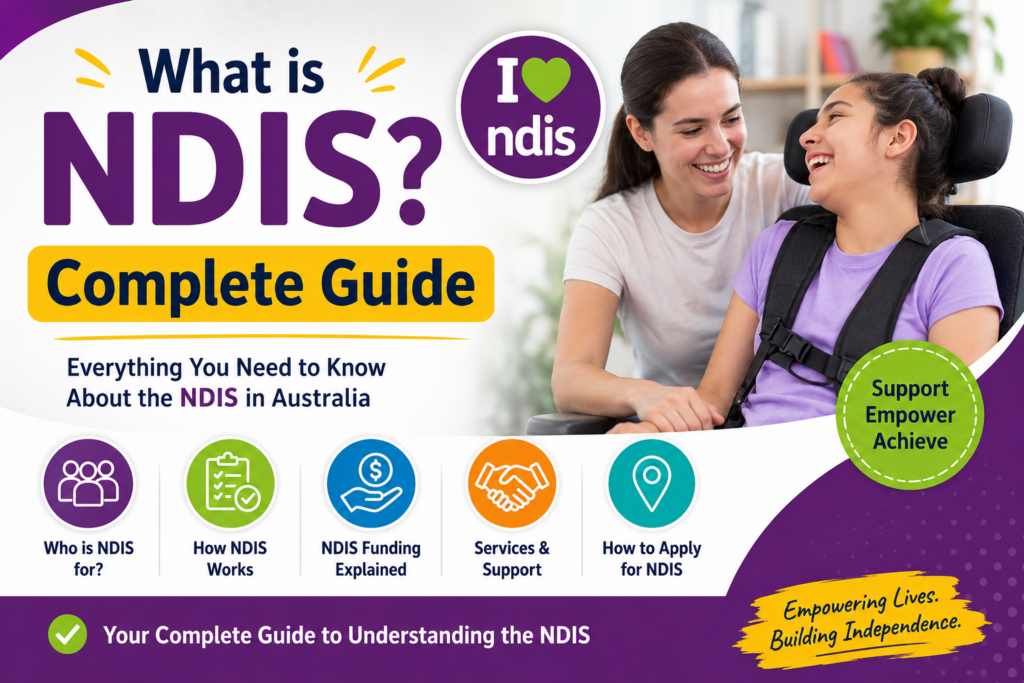
If you or a loved one are living with disability, you may have heard the term NDIS come up in conversation with doctors, support workers or friends. But what does it actually mean for you? The National Disability Insurance Scheme is Australia’s way of funding disability support to help people live more independent, connected lives. At Care Next Level we work with participants every day who go from feeling confused by the jargon to feeling confident and in control. This guide explains what the NDIS is, how it works, who is eligible and how you can start to access support.
2. What is NDIS?
The National Disability Insurance Scheme (NDIS) is the Australian Government’s national scheme to fund and coordinate support for people with a permanent and significant disability. The NDIS provides individualised funding rather than a one-size-fits-all welfare payment. This means each participant gets a plan tailored to their own goals, needs and circumstances.
The scheme is run by the National Disability Insurance Agency (NDIA) which assesses applications, approves plans and monitors the use of funding. The NDIS goes way beyond just funding therapy or equipment – it can cover anything from personal care and community access to assistive technology, home modifications and early childhood intervention.
The NDIS is designed to give participants choice and control, unlike previous state-based disability systems. Participants choose their own providers, how the support is delivered and can switch providers if a service is not working for them, rather than being assigned to the closest available service. It is this shift – from a rationed, provider-led model to a participant-led model – that makes the NDIS fundamentally different from the systems that went before it, and why knowing how to navigate it well makes such a difference to outcomes.
3. History of NDIS
The NDIS was created after a 2011 Productivity Commission report found Australia’s disability support system was underfunded, patchy across states and left many people without the proper care. The report put forward the idea of a national insurance-style scheme and it was quickly taken up by politicians from both parties.
The legislation to establish the scheme – the National Disability Insurance Scheme Act 2013 – was passed with cross-party support, and the NDIS started as a series of trial sites in 2013, testing the model in selected regions before a broader rollout. The scheme went national by 2016, replacing a hodgepodge of state and territory disability services with one national approach.
Since the NDIS fully rolled out, it has expanded rapidly and now supports hundreds of thousands of Australians. The growth has also attracted attention to cost and sustainability, with a raft of reforms in recent years to tighten eligibility, improve assessment consistency and ensure the scheme’s long-term financial sustainability — changes still playing out today.
4. How NDIS Works
The concept of individual plans is at the heart of the NDIS. Once a person is found eligible, the NDIA works with them to develop a plan that meets their goals, whether that’s finding a job, developing daily living skills, participating in the community or simply being safe and comfortable at home. Funding in the plan is generally divided into three categories: Core Supports (day-to-day activities and assistance), Capacity Building Supports (skill development and therapy), and Capital Supports (equipment, technology, and home or vehicle modifications).
Participants can decide what happens to their funding. NDIA-managed (“agency-managed”) funding is where the NDIA pays registered providers directly. Plan management means that an independent plan manager deals with payments and paperwork for the participant. This gives access to registered and unregistered providers. Self-management allows participants to control their own funding and choose from almost any provider. It offers the most flexibility but also the most responsibility.
The plans are reviewed periodically to assure that the funding continues to meet the needs of the participant. More recently, the NDIA has been moving to longer plan periods with less routine reviews, to reduce the administrative burden while still checking in when circumstances really change.
Importantly, the NDIS is not intended to replace mainstream services such as Medicare, public housing or the education system – it is designed to work alongside them and fill the gap created by a person’s disability-related support needs.
5. Who is Eligible?
Generally, an applicant needs to meet requirements in three broad areas to be eligible for the NDIS: age, residency and disability.
Age: Must be under 65 at time of initial application. The NDIS approach to early childhood supports younger children, particularly those under 9, with early intervention rather than a long formal assessment process.
Residency: Applicants must be Australian citizens, permanent residents or hold one of a small number of eligible visa types and live in Australia.
Disability or early intervention requirements: Applicants must have a permanent disability (intellectual, cognitive, neurological, sensory, physical or psychosocial) that substantially affects their ability to participate in everyday activities without support. Younger children with developmental delays may qualify through the early intervention pathway which can help prevent needs from growing later in life.
It is useful to be aware that eligibility depends not only on having a diagnosis that is on a list, but also on the degree to which a condition impacts everyday life in such areas as mobility, communication, self-care and social participation. The rules for eligibility are also changing, with the government moving gradually towards assessments based on functional capacity versus diagnosis alone, so it’s best to check the current criteria on the official NDIS website or talk to a provider before applying.
6. Types of Disability Supported
The NDIS is meant to be broad and not restrictive, focusing on permanent disabilities in many areas of functioning, not a fixed list of diagnoses. The usual categories are:
- Physical disability – conditions that affect mobility, strength or motor function, such as spinal cord injury or cerebral palsy.
- Intellectual disability – conditions that impair learning, reasoning, and adaptive functioning.
- Sensory disability: Visual impairment or hearing impairment with a significant impact on daily life.
- Neurological conditions – acquired brain injury, epilepsy and multiple sclerosis.
- Psychosocial disability – disability that is the result of a mental health condition and where the impact is significant and ongoing.
- Autism spectrum disorder- especially when there are significant functional impairments in communication and daily life.
- Developmental delay – For young children who may not yet have a formal diagnosis, but demonstrate developmental delays.
The label applied to a condition is not as important as the permanent and substantial impact the condition has on a person’s day to day functioning. This is why two people with the same diagnosis may have very different NDIS outcomes depending on how the disability impacts on them as individuals.
7. How to Apply
Applying to the NDIS starts with an Access Request. There are a few ways to begin this process:
- Call the NDIS on 1800 800 110 and ask to start an Access Request over the phone — often the quickest way to get moving.
- Complete the Access Request Form, available on the NDIS website, filling in the sections about your personal details and disability, with a treating health professional completing the evidence section.
- Contact a Local Area Coordinator (LAC) or Early Childhood Partner, especially useful for children under 9 or anyone unsure whether they meet eligibility.
Before you apply, gather supporting evidence – proof of identity (driver’s licence, passport or Medicare card) and documentation from treating professionals outlining the diagnosis, how permanent it is and how it impacts day-to-day functioning. Concrete, concrete evidence of real effects on mobility, communication, self-care or social participation makes a huge difference in how smoothly an application goes through.
The NDIA assesses the application against the eligibility requirements once the application has been submitted. Once approved, participants enter the planning phase where goals are discussed and a personalised plan is developed. There is a formal review and appeal process if an application is refused and working with an experienced support coordinator or provider can help strengthen a resubmission.
8. Working with Service Providers
Once a plan is approved, the real difference in quality of life comes in choosing the right service providers. Providers can be large, multi-service organisations or small, specialist local businesses. Participants have the right to choose and change providers as they wish.
Seek out organisations with clear pricing (based on the NDIS Price Guide), good communication, and a willingness to understand your specific goals, rather than providing generic, one-size-fits-all services. Providers may need to be registered with the NDIS Commission depending on the type of support they provide. This is increasingly the case for higher-risk supports like Supported Independent Living, while many other services can be provided by registered or unregistered providers depending on how a plan is managed.
A good working relationship with a provider is based on regular check-ins, honest feedback and flexibility as needs evolve over time.” If a provider is not meeting expectations, participants have the right to end the arrangement and choose another – the NDIS is about choice for participants, not obligation to any one organisation.
9. Your Rights as a Participant
As an NDIS participant, you have the right to be treated with dignity and respect, to make informed choices about your own supports and to set the goals that will shape your plan. You can select your own providers, change them if they’re not a good fit and decide how you want to manage your funding – whether that’s self-managed, plan-managed or agency-managed.
You also have the right to: access information in a way you understand; have an advocate or support person involved in decisions if you choose; request a review if you do not agree with a decision about your access or your plan. Ultimately, the NDIS is about your goals, not the other way around.
10. Next Steps
If you want to know what NDIS support could do for you or someone you love, the team at Care Next Level can help you understand your options, prepare a strong application and connect you with the right supports. To begin today visit carenextlevel.com.au.